Paramount's 470m Warner warrants strike 17% above its share price
The sweetener Paramount is handing shareholders on 13 October pays nothing unless the stock rises 17%, and the company can only call it back if the shares nearly triple.
Paramount Skydance will hand its shareholders about 470 million warrants on or about 13 October. The lowest price at which any of them can ever be exercised is $12.00 a share. Paramount's own stock closed at $10.28 on Monday.
That gap, just under 17%, is where this merger has actually got to. The company is distributing 470 million rights to buy stock at a price the market has not seen since the spring, as compensation for a deal it now describes, in its own filing, as one whose closing timing "if any, is not yet certain".
The terms come from the Form 8-K Paramount filed with the SEC on 25 September. The record date is the close of business on 5 October. The issue date is on or about 13 October. The whole distribution is contingent on the Warner Bros. Discovery acquisition completing, and Paramount reserves the right to cancel or postpone both dates if it does not. Variety reported the filing on Friday.
What 470 million warrants are actually worth
A warrant is a right to buy a share at a fixed price, at your option, for a fixed period. If the share never trades above that price, the warrant is worth nothing and nobody exercises it. That is the part worth holding on to here, because the arithmetic is unusually one-sided.
Paramount had 1,090,445,692 Class B shares outstanding on 31 July, according to the cover page of its second-quarter 10-Q. The warrant tranche is equal to 43% of that. Exercised in full at the $12.00 floor, it would issue 470 million new Class B shares and bring in $5.64bn. At the $16.02 ceiling, $7.53bn.
Put $5.64bn against what the company is currently worth. Paramount's two share classes together come to 1,121,945,779 shares, or about $11.5bn at Monday's close. The floor exercise alone would raise close to half the market value of the entire business.
None of it arrives unless the shares go up first.
The exercise price is not fixed yet. It will be the average daily volume-weighted price of the Class B stock over the 20 trading days ending three business days before the merger closes, subject to a hard floor of $12.00 and a hard ceiling of $16.02. With the stock at $10.28, the floor binds. Paramount would need a 17% rally in the three weeks before completion for the formula to produce any number other than $12.00.
Then there is the call provision. Paramount can force the warrants to expire early, but only after the third anniversary of issue, and only if the Class B shares close at $30.00 or better on 20 trading days inside any 30-day window. Thirty dollars is 2.9 times Monday's price. It is 49% above the stock's 52-week high of $20.09. Otherwise the warrants run for ten years.
A sweetener that pays nothing unless the shares rise 17%, and that the company can only take back if they nearly triple, is not really a sweetener. It is an invitation to place a bet on the thing you were already holding.
The $12.00 floor should also look familiar. It is the same price Paramount set when it sold equity to an investor syndicate last week with the stock at $10.18. Twice in a fortnight, the company has priced its own paper at $12 and the market has priced it at ten and change.
The clock that starts on Thursday
The merger agreement announced in February said the deal was expected to close in the third quarter of 2026. The third quarter ends on Wednesday.
From 1 October, Warner Bros. Discovery shareholders begin earning a ticking fee: $0.25 a share for each quarter the deal stays open, measured daily, added to the $31.00 cash price and paid as a lump sum at closing. TheWrap puts the daily rate at $0.00277778 a share and the cost at roughly $650m a quarter, or about $7m a day.
Run it against the filed share count and the figure comes out slightly lower. WBD reported 2,510,703,314 Series A shares outstanding as of 23 July in its second-quarter 10-Q. At $0.00277778 a day, that is $6.97m a day, and $641m across the 92 days of the fourth quarter rather than $650m. Small difference. It is $9m.
If the deal runs to 1 June 2027, the outer date Paramount agreed with the court in July, the fee accrues for 243 days: $1.69bn, or 67.5 cents on top of every $31.00 share. Paramount's regulatory break fee is $7bn, which is why nobody expects the ticking fee alone to change anyone's behaviour. It is the cost of the calendar slipping, not a penalty.
What Paramount has said about closing, in order
Laid end to end, the company's own language has moved further in six weeks than the litigation has.
- 26 February: WBD's board ruled Paramount's revised offer superior to its agreed deal with Netflix, and Netflix withdrew. $31.00 a share in cash, $81bn of equity value, $110bn enterprise value, closing expected in the third quarter.
- 20 July: a federal court granted a temporary restraining order sought by a coalition of state attorneys general, freezing the merger, as NPR reported.
- 24 July: Paramount agreed not to close until the earlier of five days after a decision on the merits, or 1 June 2027.
- 14 August: Paramount announced it had satisfied every regulatory condition in the merger agreement, with clearances in 68 countries, and said it and WBD "could and would close today".
- 21 September: Paramount settled with the state attorneys general, subject to a five-year consent decree covering film production spending, the studio lots, exhibitor terms and editorial oversight of CBS News and CNN.
- 24 September: US District Judge Araceli Martínez-Olguín questioned the settlement at a hearing and said a ruling would come "in due course", per Variety.
- 25 September: the 8-K. "The ultimate timing for the closing of the WBD Merger, if any, is not yet certain."
Forty-two days separate "could and would close today" from "if any". Nothing in the record suggests the regulatory position changed in between. What changed is who is deciding.
Martínez-Olguín also directed both sides to respond by noon Pacific on Monday to a letter from Senator Cory Booker of New Jersey, who asked the court to review the consent decree independently rather than enter it as drafted. Booker's point, published by his office, is that the states sued for an injunction blocking the merger outright, and a decree about spending commitments does not answer that.
None of the warrant timetable waits for her. Nasdaq trading in PSKY ends at the close on or about 5 October, and the stock begins trading on the New York Stock Exchange the following morning under the same ticker. The record date falls on the same day the Nasdaq listing ends.
The ticking fee starts on Thursday, whatever the judge decides.
Reporting this piece draws on
- U.S. Securities and Exchange Commission Paramount Skydance Corp, Form 8-K, 25 September 2026
- Variety Paramount Says Timing for Warner Bros. Deal Close 'If Any' Is 'Not Yet Certain' but Pencils In Oct. 5 Date to Issue PSKY Shareholders Warrants
- U.S. Securities and Exchange Commission Paramount Skydance Corp, Form 10-Q for the quarter ended 30 June 2026
- U.S. Securities and Exchange Commission Warner Bros. Discovery, Inc., Form 10-Q for the quarter ended 30 June 2026
- U.S. Securities and Exchange Commission Warner Bros. Discovery, Inc., Form 8-K announcing the Paramount merger agreement
- TheWrap Paramount-Warner Bros. Ticking Fee: Everything You Need to Know About the M&A Time Bomb
- Variety Judge Questions Legal Points of Paramount's Settlement With States at Hearing, Says a Ruling Will Come in 'Due Course'
- Office of Senator Cory Booker Judge Directs Paramount, State AGs to Respond to Booker Letter Urging Court to Scrutinize Paramount-Warner Bros. Discovery Merger Settlement
- NPR Court ruling freezes Paramount-Warner Bros. merger for now
- Paramount Paramount Skydance Satisfies All Regulatory Conditions Under the Merger Agreement to Close Warner Bros. Discovery Acquisition
- CNBC Paramount and state AGs settle lawsuit, allowing Warner Bros. merger to proceed
- StockAnalysis Paramount Skydance Corporation (PSKY) stock price and 52-week range
- GuruFocus Paramount Skydance (PSKY) to Transfer Listing to NYSE and Sets Warrant Distribution Record Date
The writer
Marcus Dey — Deals, development and the people who move between them, written for readers who want to know why a project exists at all.
More from News
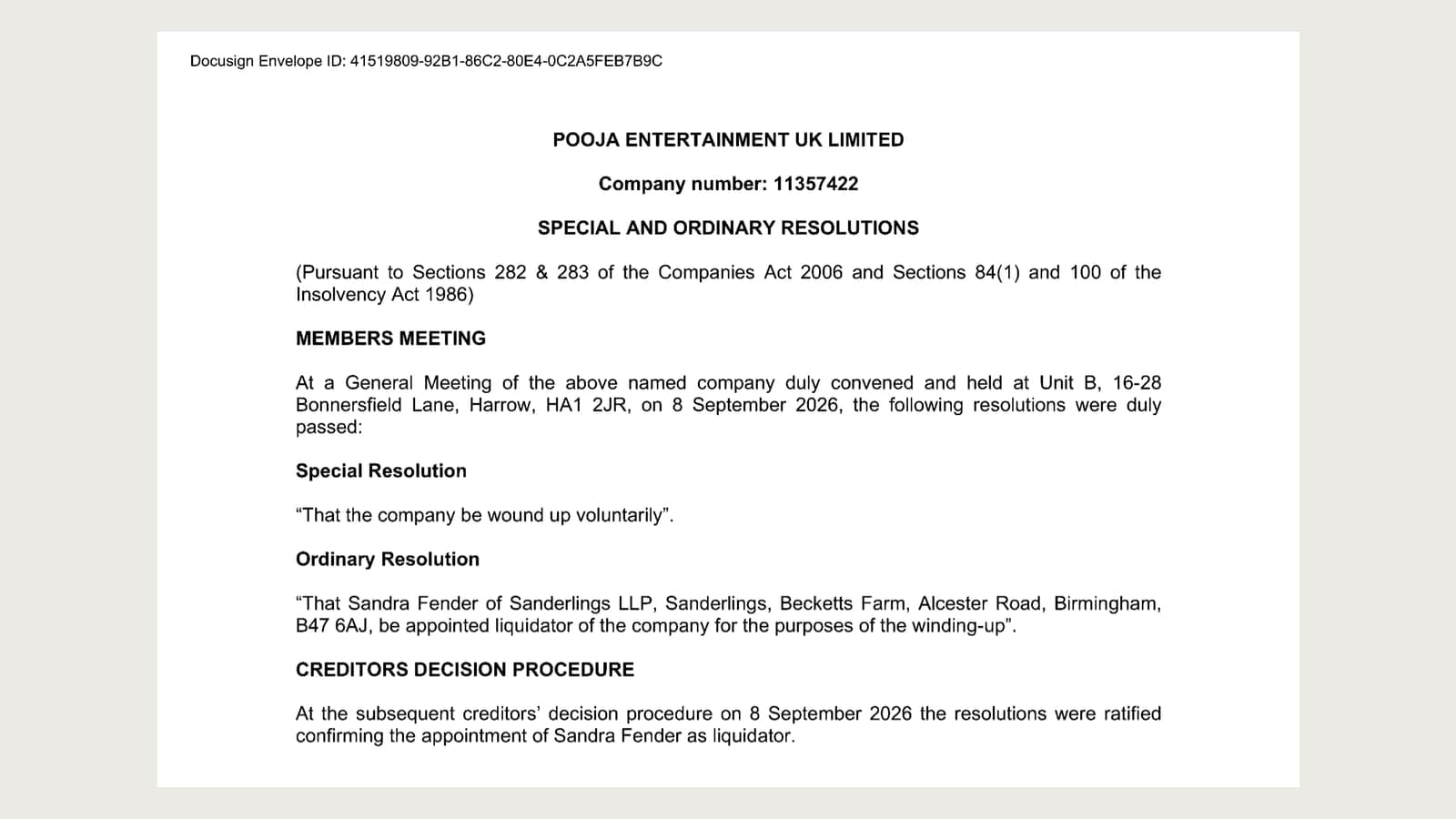
Vashu Bhagnani's UK company owes £10m, 87% of it to a UAE firm
Pooja Entertainment UK Limited's statement of affairs, filed on 17 September, puts its debts at £10,085,267.92. A single creditor in the United Arab Emirates accounts for £8,752,652.35 of it.

Aegon's Conquest is Game of Thrones' 12th spin-off. Two have aired
HBO and Warner Bros have put at least twelve Game of Thrones projects into development since May 2017. House of the Dragon and A Knight of the Seven Kingdoms reached a screen. The twelfth, Aegon's Conquest, is now a film dated for 1 June 2029.

Jon Watts gets the Star Wars trilogy Lucasfilm said wasn't Episode X
Rey's return to cinemas has now been handed to four writing teams and two directors in 41 months without a day of filming, and the one Star Wars film Lucasfilm has released this decade made 32% of what The Rise of Skywalker took.