A True Warrior is a 30-minute AI film made in a single day
Arman Khan Achakzai generated a half-hour period war film in a day, and gave its villain the face of Balochistan content creator Sultan Haji Akhaa.
A thirty-minute period war film made almost entirely with generative video tools has been completed by a single director, and its villain wears the face of a man his audience already knows.
A True Warrior, directed by Arman Khan Achakzai, runs to half an hour: longer than the AI shorts that have circulated this year, shorter than the AI features now reaching festivals. The antagonist is Sultan. He is played by Sultan Haji Akhaa, a content creator with a substantial following in Balochistan, who lent his own face to the character.
That casting decision is the interesting part, and it is not a technical one.
Why a familiar face changes an AI film
The AI films that have travelled furthest this year have had a recognition problem. Dreams of Violets, the $2,000 feature that premiered at Tribeca in June, is populated entirely by faces that belong to nobody, which is efficient and also weightless: an audience has no stake in a stranger who was never a person. We wrote about that gap in our piece on whether AI is a threat to filmmakers.
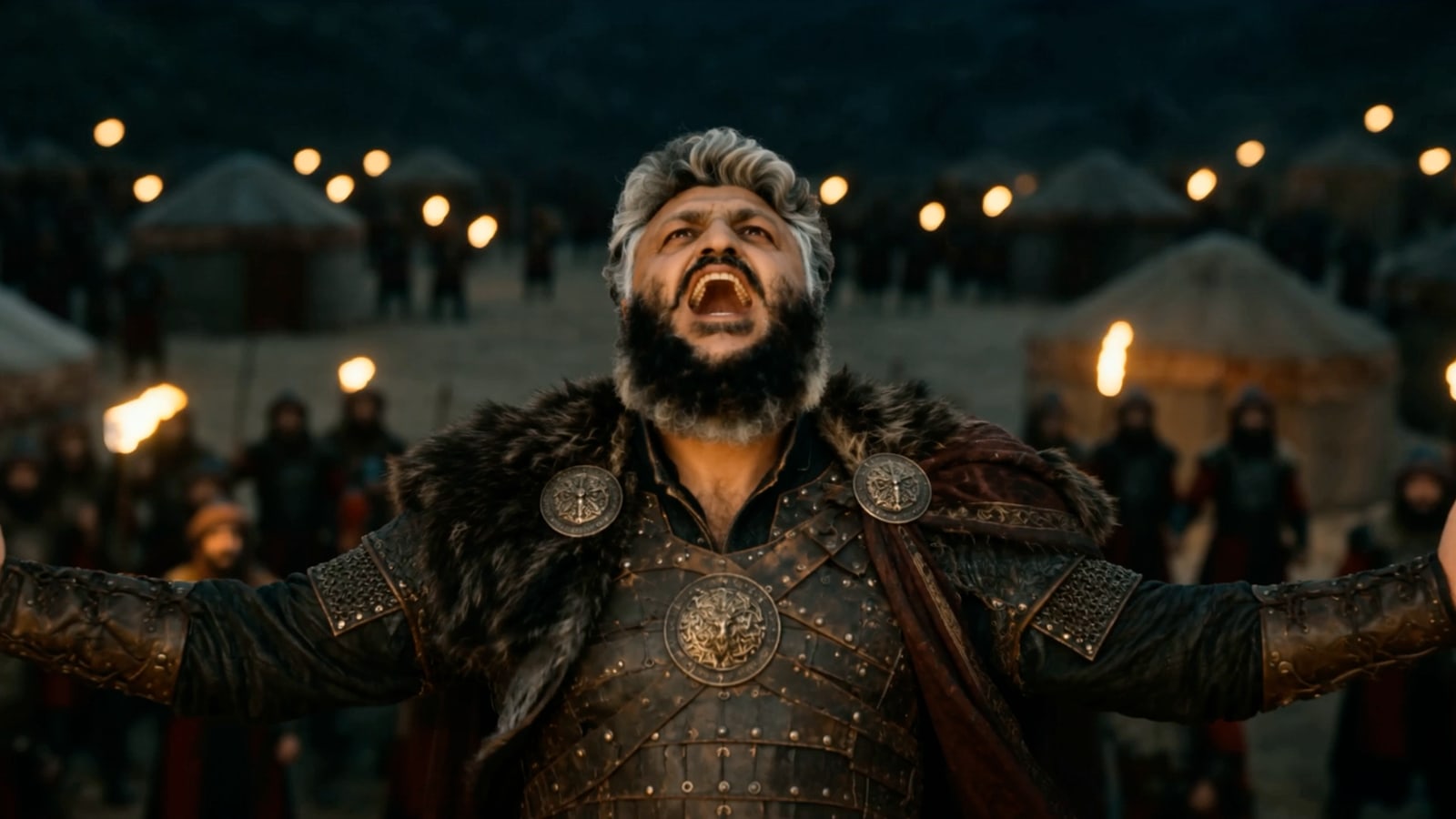
Sultan, played by the Balochistan content creator Sultan Haji Akhaa. Courtesy of Arman Khan Achakzai.
Casting a known creator as the villain solves it the old-fashioned way. Sultan arrives on screen with an existing relationship to the people most likely to watch, and the film spends that credit immediately: the audience recognises him, then watches him become someone worse. Casting directors have used the same trick with television actors for decades. What is new is that the performance is generated rather than filmed, while the likeness belongs to a living man who said yes.
Consent is the line that matters here, and it is the line most AI projects have crossed. Neill Blomkamp licensed the faces and voices of 32 people for his thirteen-minute Nightborne in July. The Tilly Norwood affair went the other way, and SAG-AFTRA's response to it was that "creativity is, and should remain, human-centered". A named creator agreeing to play a named villain sits on the right side of that argument.
What the film looks like
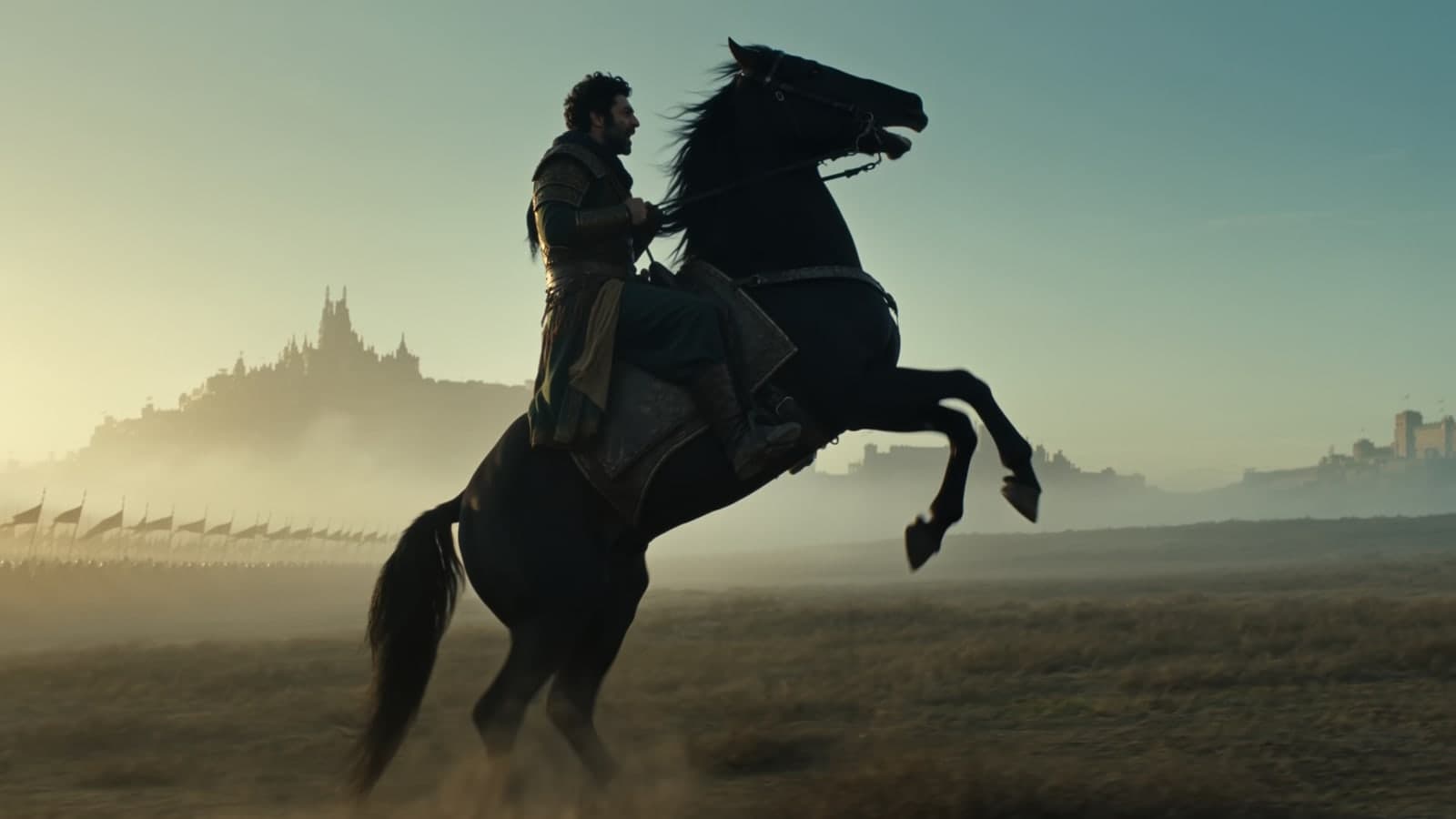
The frames released so far are not the soft, drifting images that gave the first wave of AI video its reputation. They are composed like a period epic: a rider silhouetted on a rearing horse against a field of green banners at sunset; a commander in embroidered armour in front of a mountain fortress, his men out of focus behind him; a grey-bearded chieftain in fur, shot close in profile; a blade held vertically across a bloodied face, an army blurred behind it; a sword planted upright between two battered shields as the light goes.
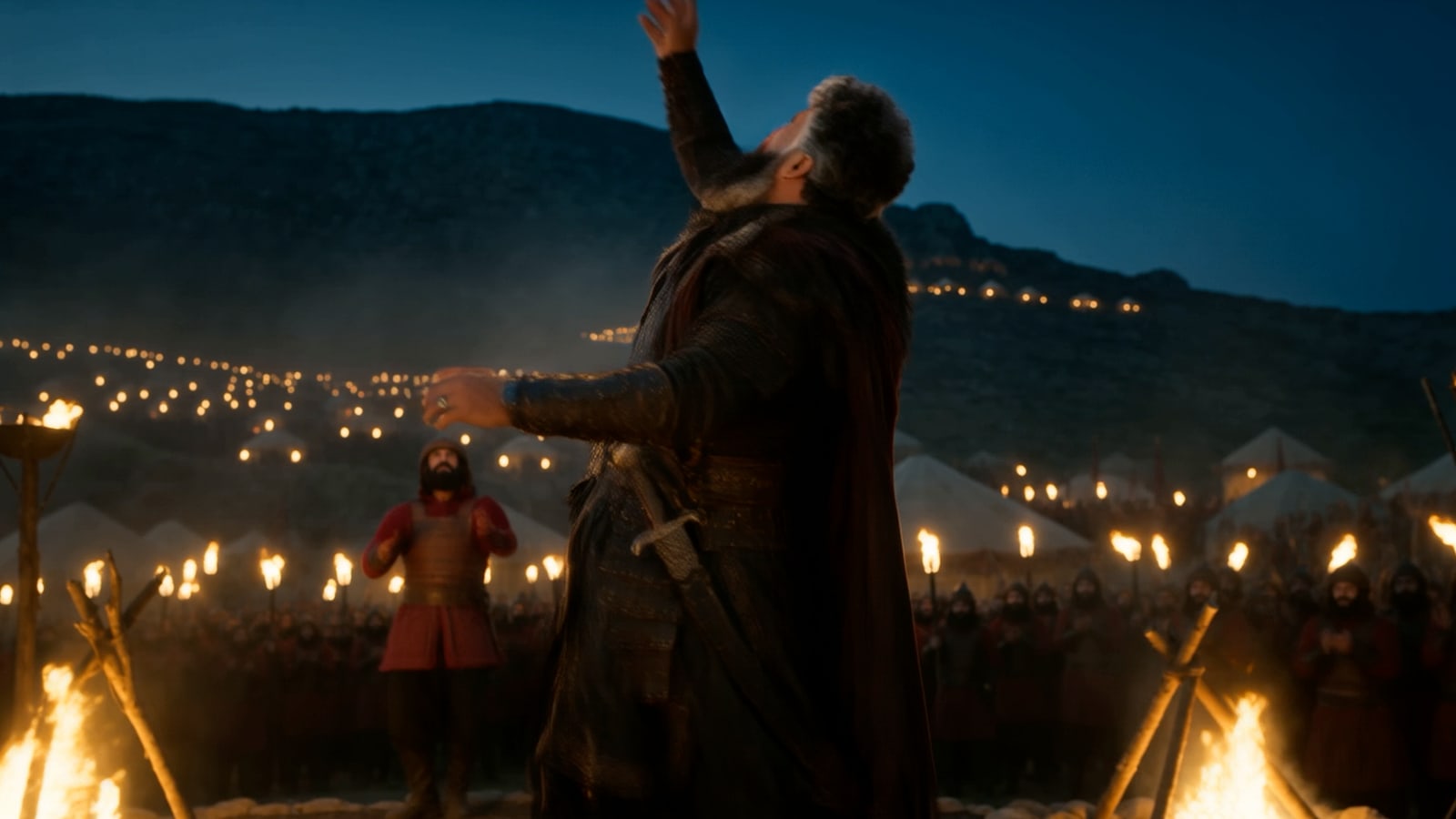
Torchlight, crowds and metal: the three things generated footage usually fails at. Courtesy of Arman Khan Achakzai.
Those are the shots of someone who has watched a lot of cinema. The banner ranks, the low sun, the shallow focus on a face in a crowd: a visual language borrowed from large-scale historical drama, which is exactly the register AI video is worst at sustaining, because crowds, horses and metal are where generated footage usually falls apart.
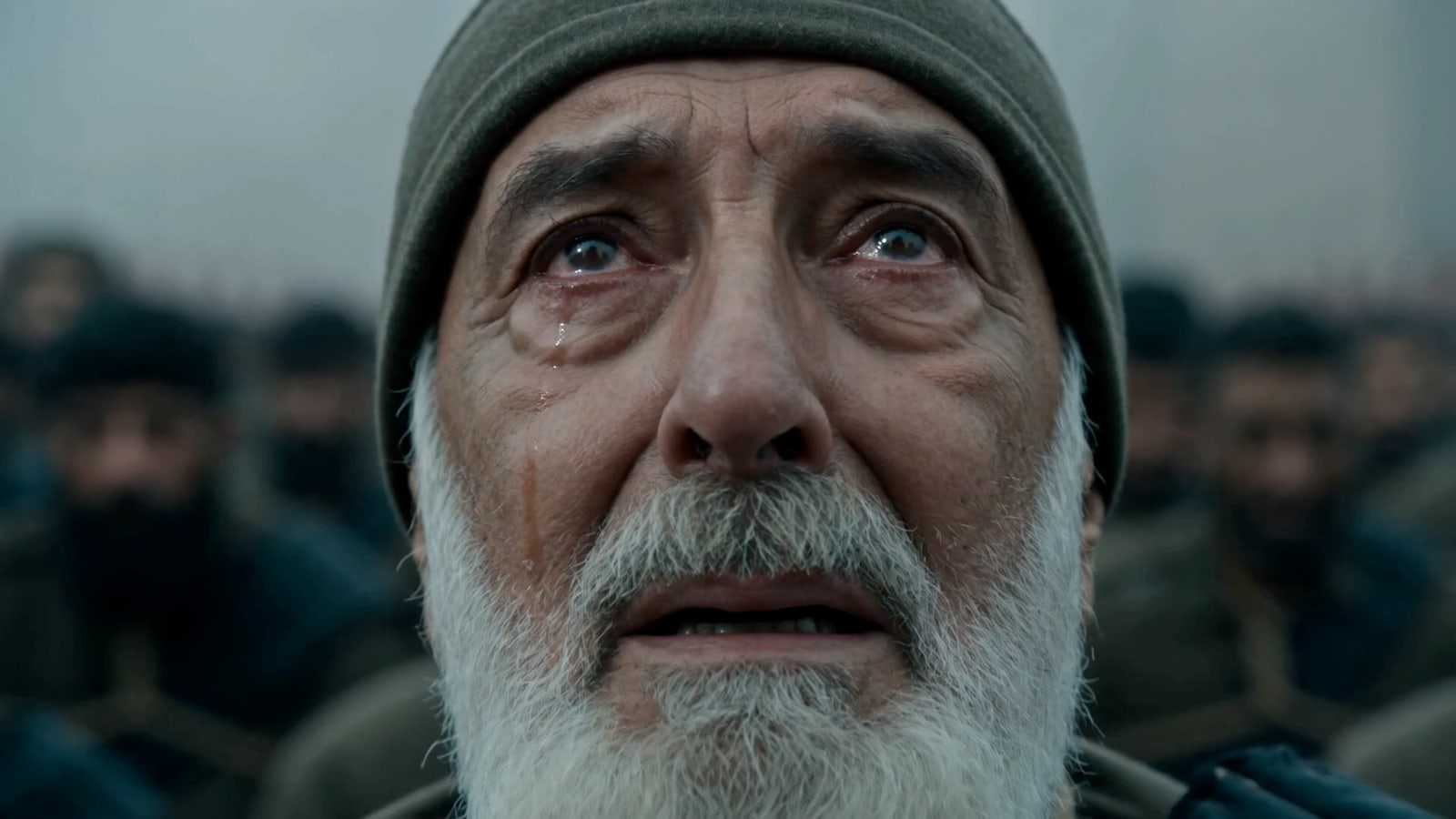
A face held steady in close-up, the hardest thing to sustain across a long cut. Courtesy of Arman Khan Achakzai.
Thirty minutes is the claim worth examining. Generated shots are cheap to make and expensive to make match: continuity of a face, a costume and a light source across hundreds of cuts is the problem nobody has solved cleanly, and it is why most AI work stops at three minutes and why Blomkamp called his thirteen-minute film a test rather than a film.
How it was made
The film was produced on visualseffect.com, the AI video platform Achakzai built and runs himself, which puts him in an unusual position: he owns the pipeline as well as the picture. Most people making AI films are renting time on somebody else's model and accepting whatever it does. Building the tool means the shot list and the platform can be adjusted against each other.
The whole thirty minutes was generated in twenty-four hours. That is the number that should stop people, and it is worth being precise about what it does and does not mean: it is generation time, not the time to write, storyboard, cut and grade, which is where the judgement lives. But a half-hour of battle footage produced inside a day is a schedule no live-action production of this scale could quote at any budget.
The human layer is thin and deliberate. Saad performs the voiceover. The score was generated on the same platform, and everything else, including the edit that has to hold thirty minutes together, is Achakzai's.
That mix is where the argument about AI filmmaking actually sits. A real voice carrying generated images is the arrangement Darren Aronofsky used for his AI history series, which employed union voice actors over machine-made visuals and was still torn apart for how it looked. The lesson from that reception was not that audiences reject the tools; it was that they notice immediately when the pictures cannot hold a face still.
Where it sits
The year's AI film story has been told through American releases: OpenAI's Critterz looking for distribution after Cannes, Dreams of Violets at Tribeca, a Higgsfield feature dumped onto YouTube. A thirty-minute historical drama made in Britain by a Pashtun director, with a Baloch creator as its antagonist, is a different proposition, and it points at the part of this shift that Hollywood coverage keeps missing. The tools are cheapest, relative to local budgets, exactly where film financing has always been hardest to find.
That is the argument for taking it seriously rather than treating it as a novelty. Nobody was going to fund a half-hour period war film from a first-time director in this genre. The cost of trying used to be the whole obstacle.
What happens next
The test for any AI film is not whether it can be made. That is settled, and twenty-four hours settles it twice. It is whether an audience will sit through half an hour, which is a question about story and rhythm rather than models, and only a release answers it. Achakzai has not yet said where A True Warrior will play.
The writer
Marcus Dey — Deals, development and the people who move between them, written for readers who want to know why a project exists at all.
More from News

Vashu Bhagnani's UK company owes £10m, 87% of it to a UAE firm
Pooja Entertainment UK Limited's statement of affairs, filed on 17 September, puts its debts at £10,085,267.92. A single creditor in the United Arab Emirates accounts for £8,752,652.35 of it.
Aegon's Conquest is Game of Thrones' 12th spin-off. Two have aired
HBO and Warner Bros have put at least twelve Game of Thrones projects into development since May 2017. House of the Dragon and A Knight of the Seven Kingdoms reached a screen. The twelfth, Aegon's Conquest, is now a film dated for 1 June 2029.

Paramount's 470m Warner warrants strike 17% above its share price
Paramount Skydance will distribute about 470 million warrants with a floor exercise price of $12.00. Its shares closed at $10.28 on Monday. The same filing says the timing of the Warner Bros. Discovery merger, 'if any', is not yet certain.